
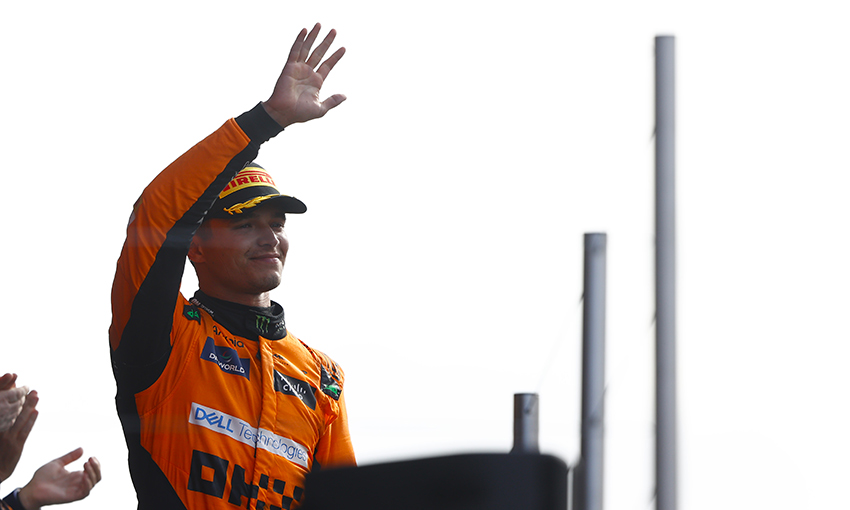
The victory in the 2025 World Championship has definitively established Lando Norris as an international elite driver, but not only that. Norris has become an example for all drivers who arrived after the Verstappen-Leclerc duo: Piastri, Colapinto, Hadjar, Bortoleto, Bearman, Antonelli, and the debutant Lindblad all share characteristics with the new number 1 of Formula 1.
ROBOT AT THE SIMULATOR
Certainly, in the current situation F1 drivers have access to extremely useful technologies to improve. First of all, the simulator, which allows drivers to work tirelessly even off the track. This tool is extremely important for analyzing and studying every track down to the millimeter: if today we can see drivers brushing the walls on street circuits by just a few millimeters, the credit goes mainly to the hours of training on the simulator, with the aim of finding the ideal racing line.
And then there is the matter of the physique. Athletic training, which was introduced in this sport during Ayrton Senna’s era, has seen significant improvements. Specific exercises for the muscles, particularly for the neck, ensure greater strength for drivers when tackling braking and the toughest corners. And not only that: cardio work is emphasized to improve drivers’ endurance, constantly monitoring the driver’s values both under strain and in routine conditions. Finally, diet is no longer underestimated. Nowadays, more than just drivers, athletes are nurtured from the lower categories almost in every aspect.
IS THE TRUE SPIRIT OF RACING BEING LOST?
In short, the latest drivers who have arrived in F1 are practically flawless from every point of view. However, it’s as if this quest for perfection is ruining other aspects of racing. Let’s take Lando Norris as an example. The Englishman is an extremely technically proficient driver, very fast, and perfect even in front of the cameras, yet Norris has flaws that champions of the past certainly did not have. Above all, the tendency to overtake: in general, we are starting to lose that very instinct at the heart of racing, the willingness to attempt an overtake in prohibitive conditions. The impression is that today’s drivers (it’s not a point that applies to everyone) feel the track less and are more than ever driven by the team.
Always using Norris as an example, a lower adaptability can be seen in this generation. In 2021 in Sochi, Norris threw away a certain victory by not listening to his team and choosing to stay out on slicks, when it was clearly starting to rain. Whether willingly or not, younger drivers give the impression of being less independent in their decisions and, perhaps, of not having such a great passion for racing. This is also noticeable outside the paddock, with top drivers more focused on sponsorships and social life, leading a superstar lifestyle rather than that of a true driver.



Lascia un commento